














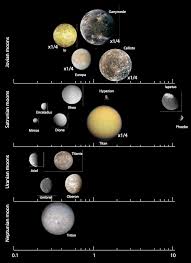
This article is the big finish for the Solar System. But, as I said in the sub-title, I’ll be hitting the highlights of the them because there’s just too many.
Total(ish) Count of Moons Per Planet:
Jupiter: 95+
Saturn: 146-274 (depends on source)
Uranus: 28
Neptune: 16
Jupiter/Galilean Moons
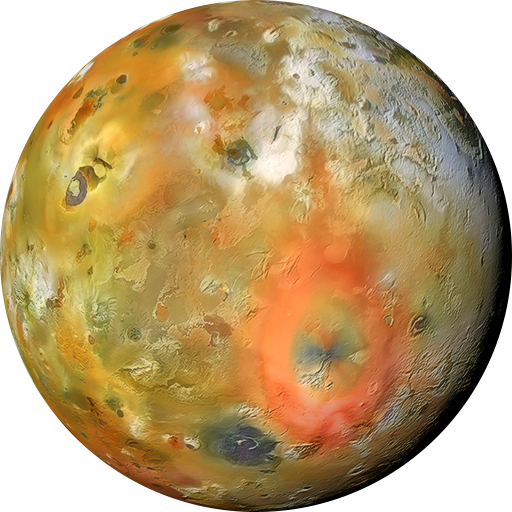
Io: You could say that Io looks like a pizza, and you wouldn’t be too far off. Io is the most volcanically active moon in our Solar System. You can’t see it in the picture below, but Io is covered in lava, and its most active volcano can spray lava 300 miles (500 kilometers) high! If you were in Rolla MO and you drove to Chicago IL, that would be around the same distance.
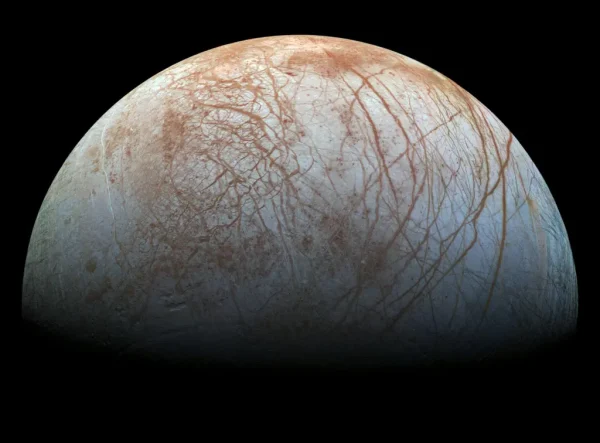
Europa: Jupiter’s ocean moon, Europa (not to be confused with Europe) has a cracked, icy surface that looks stunning. Under that ice, though, there is an ocean (hence the name “ocean moon”) which is very large. I would give an exact size, but no one is really sure. In 2024, we launched the Europa Clipper, which will study this ice moon. It’s scheduled to arrive in 2030.
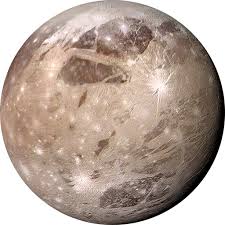
Ganymede: This is the largest moon in the Solar System, which is fitting for the largest planet. As seen in the photo, it looks a lot like our moon, but with no maria (definition here), and a lot more craters.
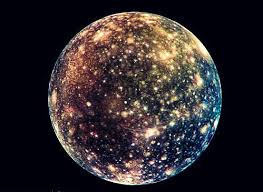
Callisto: Looks like it’s covered in pockmarks (or cities if you have a creative mind), right? This image is enhanced to show different colors for different minerals and such things. Callisto’s real color is more like Ganymede’s. But the spots you see are visible in the real light* pictures too.
I wish I could tell you more about these last two (Ganymede and Callisto). Sorry!
Saturn/Enceladus and Titan
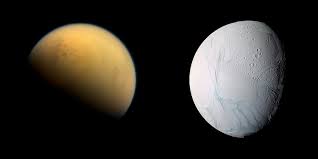
Titan: This moon is the second largest moon in the Solar System, making it one of the more well-known ones. Titan has methane and ethane lakes and seas on its surface, and it also has weather! The methane/ethane in the lakes evaporates, makes clouds, then falls as rain to the moon’s surface.
Enceladus: Enceladus is another ice moon, and is famous for its ice geysers, which shoot ice water over 9,600 km (6,000 miles) high! That’s around 2.5 times the size of Route 66! (Meaning you can put roughly 2.5 of them end to end)
Uranus/Miranda
Miranda, being a moon, doesn’t have tectonic activity, though it might look like it does. Its surface has coronae (NOT CORONA), which are geometric shapes that contrast the cratered terrain around it. Scientists aren’t sure how it acquired this surface, but there’s many theories out there.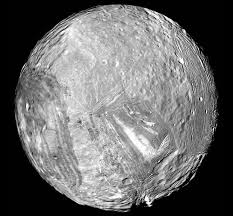
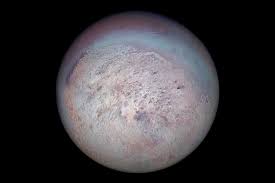
Neptune/Triton
Triton is the largest of Neptune’s moons. It is the only moon in our Solar System that orbits in the opposite direction of its planet, called retrograde. It’s composition is similar to Pluto’s, making scientists suspect that it was drawn in by Neptune’s gravity from the Kuiper Belt. Like our moon, it is tidally locked, meaning one side faces the planet at all times.
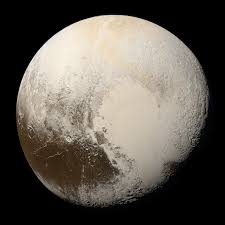
Dwarf Planet Pluto
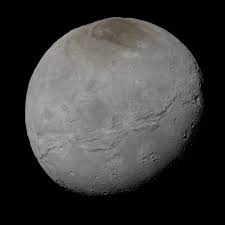
Pluto is one of the many dwarf planets that reside in the Kuiper Belt just outside Neptune’s orbit. Its moon Charon is very close to its surface. That’s just one of the many reasons it was withdrawn from the normal planets. Other reasons include its size and orbit.
*Real light means a normal photo, not enhanced or using a special filter to see strange colors.
One more article after this! I’m running out of school time to post, so I hope you have enjoyed this series.