













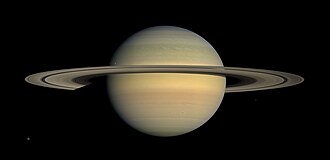
Hello again! It’s time for the second biggest planet, Saturn!
Size/Formation
While Saturn is smaller than Jupiter, it’s still nine times bigger than Earth. To make an analogy, if Earth were the size of a nickel, Saturn would be a volleyball!
Unlike Jupiter, Saturn was formed with the rest of the gas giants about 4.5 billion years ago. But it is made of the same gasses, which are hydrogen and helium. In my last article, I said at the end that Jupiter went a bit rogue in its “teenage years” (meaning almost 1 billion years old). Well, Saturn actually played a part in wrangling Jupiter in. When Saturn formed, its gravity pulled Jupiter back to where it is now.
Surface
Since Saturn is a gas giant, it has no surface. Well, it does, but in the form of gasses. Unfortunately that does mean that the further down you go, the atmospheric pressure would crush you. And melt you. It’s never a good idea to skydive on a gas giant. (By the way, air has weight, so it acts like water pressure.)
Rings
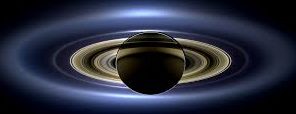
Saturn is the only gas giant with visible rings that are noticeable immediately. Made of dust, ice, and asteroids, or maybe even destroyed moons, Saturn’s rings are like the landmark of our solar system. Unfortunately, you can’t walk on the rings, even though they look flat from a distance. There are a few moons within the rings, which I’ll talk about in my “Moons of the Outer Solar System” article. These moons are called shepherd moons because they keep the rings separate.
Oh yeah! There are multiple rings, labeled from when they were found. There’s a gap in the rings called the Cassini Division, and the two main rings are called ring A, ring B, and ring C. The rest of the rings (Labeled ring D, E, F, and G) are fainter and were discovered more recently.
Laters!
Source: Saturn: Facts – NASA Science
Ellyn H. • Feb 3, 2026 at 11:45 am
Love it kathryn!! Wonderful job, i am the first biggest planet 🙂