


















As I said in my last article, I am running out of time at school, so this is the last one. There was so much more I had planned to talk about, but I have to come to a close here. If you haven’t seen any of my other articles, put “milky way” into the search bar. It’s now time for black holes!
So what even is a black hole?
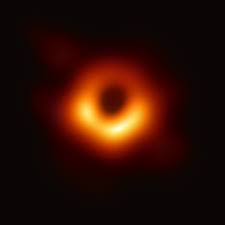
A black hole is a point of infinite gravity that destroys everything that gets too close to it. There are two types: supermassive and stellar-mass, with the latter as the more common. Supermassive black holes are, obviously, really really big. Common to galaxy centers, most lie dormant, like our own Sagittarius A* (the photo next to this paragraph is an actual image of it). Stellar-mass black holes are smaller, generally five to 100 times the mass of our Sun (hence the name).
How do they form?
Black holes are generally formed from humongous stars that are at the end of their life span. Their core collapses, sometimes creating a supernova in the process. That core becomes a point of gravity which grows infinitely, creating the black hole. Others can form from collapsing clouds of gas, which may be how early supermassive black holes came to be.
Why are they dangerous?
Because:
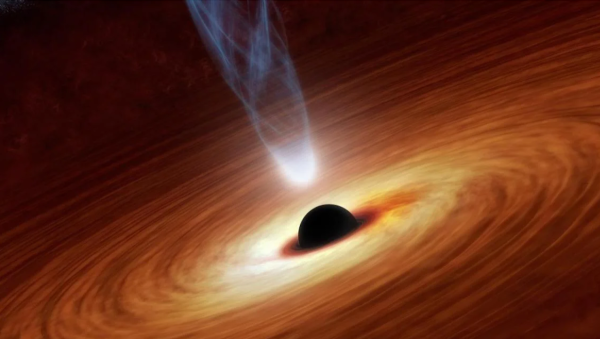
They have a disk around them composed of swirling hot gas called the accretion disk. That alone can kill you if you enter it, given its temperature (can be in the billions of degrees Kelvin).
If you enter a zone just outside the black hole, called the event horizon, you’re doomed. If you cross that point, nothing, not even light, can escape. Some scientists theorize that you would go through a process called spaghettification, which stretches your body into oblivion.
Recent discoveries
Scientists are still learning things about these objects. For instance, LIGO (Laser Interferometer Gravitational-wave Observatory) proved one of Albert Einstein’s theories true with the discovery of gravitational waves. They are created when space-time warps. The most famous discovery from them is when two black holes merged. Here’s a link to what that sounded like. We’ve also seen a black hole wake up for the first time. In December of 2019 a galaxy suddenly brightened, and in early 2024, scientists confirmed it was a black hole waking up from a long period of inactivity.
A Youtuber I watch created a video called “Animation vs. Physics”. It is really informative, and has a black hole at the end. Here’s a link to that.
I hope you learned something from these articles. Bye!